The Anthropology of Campus Social Habits
An observational look at the unspoken social maps of our university
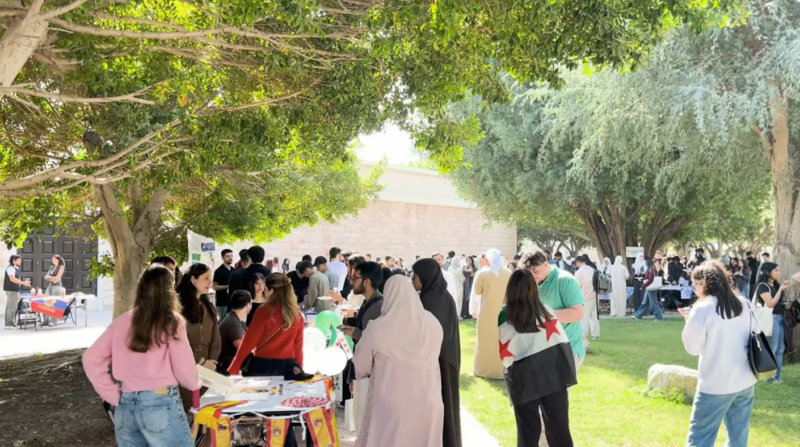
Walk into the Student Center building on any given Tuesday afternoon, and you’ll witness something everyone at AUD notices but rarely discusses out loud: our campus has invisible borders.
Now of course, It’s not written in any student handbook, and there’s no official policy dictating who sits where, obviously. Yet somehow, if you spend enough time observing the social geography, patterns emerge as clearly as the building floor plans themselves.
Enter through the main doors of the C building, and you’re immediately in C1. The first floor hums with a particular energy, quieter, more relaxed. Students sit at tables with laptops open, conversations happening at a measured volume. Starbucks does steady business, although many carry drinks from outside cafes.
“I come here between classes because it’s calmer, and all my friends sit here” says an Emirati junior in a crisp abaya, her MacBook and iced Spanish latte perched on the corner table she claims most mornings. “I can actually focus here, or have a nice conversation with the girls.”
The aesthetic here is noticeably put-together. Whether in kanduras and abayas or linen pants, ironed shirts, and quarterzips, C1 regulars tend toward the polished end of the spectrum. Hair and nails are done, and the outfits are intentional.
“It’s mostly Emiratis and other Khaleejis down here, yeah,” she acknowledges with a slight smile. “And some other… the international students or the other students who… We’re usually here for shorter periods, it’s accessible and quick – yeah, it’s just the easiest place for us to gather and sit until class, we grab coffee, sit for a bit, then leave. None of us really live on campus so we don’t get too comfortable.”
Take the stairs, or elevator, to the second floor, and you’ve entered a different realm. C2, the second level with its sprawling couches and cluster seating, pulses with a distinctly different energy. It’s louder, younger, more sprawling. The students here don’t just pass through temporarily, they really settle in. Some look like they’ve been there since morning, and judging by the backpacks and blankets, they might not leave until nighttime.
The dress code here is decidedly casual. Sweatpants and hoodies dominate. Hair in messy buns. Slides instead of sneakers. It’s the aesthetic of rolling out of the dorms fifteen minutes before class.
“This is where the “chammaks” live,” laughs a Lebanese sophomore sprawled across a couch, legs up, with three friends, scrolling through his phone while simultaneously participating in two conversations. “We basically own this floor.” These are students who treat campus like an extension of their living room, because for many dorm residents, it essentially is. A Syrian freshman who told me he’s been camped on the same couch since 11 AM, talks about the relaxed, comfortable lifestyle of those who prefer C2, “It’s more… free? Like, we’re not worried about looking a certain way or keeping it professional. We’re just hanging out.” The conversations are different too. Less about internships and networking, more about weekend plans and the latest drama between friend groups.
But if C2 is casual, the benches outside the Engineering building take it to another level. The benches are packed, students lean against the building walls or sit on the walkway in front of Minimart. Some are smoking cigarettes, some are vaping, but plenty are doing neither, they’re just there. It’s less about what they’re doing and more about the fact that this is their spot. “We spend hours out here,” says a student sitting on a bench, “like, actual hours. Sometimes I come here after my class and don’t leave until nine.”
The energy is restless in a way that’s hard to describe. People aren’t sitting still or moving slowly, they’re getting up, chasing each other around the benches, calling out across the space, moving in and out of conversations. There’s a looseness to it all, like no one’s watching the clock or each other, or worrying about what they should be doing instead. The demographic mirrors C2 almost exactly, the dress code is hoodies, joggers, sweatpants, sneakers. These aren’t students who went home to change between classes. Most rolled out of the dorms looking exactly like this.
“It’s just different out here,” says a Egyptian junior who’s been outside since his 10 AM class ended – it’s now past 4 PM. “Inside feels like you’re still at university, you know? Out here it’s like… I don’t know, it just hits different. We can be loud, we can mess around, it’s our space.” And truthfully, there is an interesting ownership to the way students treat E-Smoke, a sense that this patch of outdoor benches and concrete and grass belongs to them in a way the “polished” interiors of C1 never could belong, in the same sense – to the people that choose C1.
“You won’t catch the C1 people out here,” he notes, not unkindly. “And honestly, we probably wouldn’t be comfortable in their space either. It’s not like there’s beef or anything, we just… different areas, you know?” What’s striking is how natural these divisions feel to everyone involved. There’s not really any hostility between groups, no exclusionary policies. The “borders” are soft and permeable. But the default patterns hold regardless, and somehow, despite complete turnover (mostly) of the student body every four years, the social geography remains remarkably constant. New freshmen arrive each fall and within weeks, without anyone explicitly telling them, they’ve found their floor, their benches, their people. The patterns replicate themselves, year after year, batch after batch.
“I think we all just found our spot.” the Emirati girl from C1 reflects. “I feel like in a university this diverse, it makes sense that different groups would have different spaces where they feel comfortable. It’s not really a bad thing, it’s just how it is…” Maybe she’s right. Or maybe, in never quite mixing, we’re missing something. Either way, the invisible maps remain, drawn and redrawn every semester by thousands of individual choices about where to sit, who to sit with, and how to spend the time between classes.