The rise of AI in newsrooms
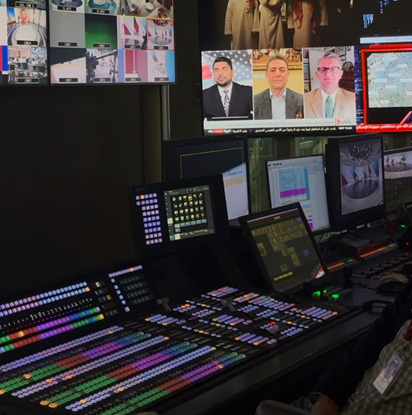
As artificial intelligence continues to be incorporated across different sectors, newsrooms are increasingly integrating it into their daily editorial processes, reshaping how journalists research, produce, and distribute stories.
Senior business reporter at CNN, Paula Naoufal, explained that AI is now “built into the day like any other production tool.” For her, when covering business, macroeconomics, or geopolitical stories AI can help navigate the overwhelming volume of information. Naoufal noted, “AI helps me scan reports, statements, earnings, policy docs, and pull what matters fast, not to decide the story, but to surface the signals quicker so I can focus on the angle and what’s actually newsworthy for our audience.”
Similarly, Dana Abu Laban, senior TV producer at MBC, explained its growing role as a “force multiplier” within the newsroom workflow, “it is now crucial for “workflow optimization” to automate monotonous processes like scheduling, translating between languages, and creating quick-response design assets for social media,” she said.
AI is also increasingly used during early-stage production. Naoufal highlighted how she uses it to save time in first drafts, “it’s great for a first structure: an outline, a clean summary, a rough script skeleton, headline options, even alternative leads.” Similar patterns are emerging across different platforms, as Abu Laban also explained, “Editorially, we collaborate with AI through ‘iterative brainstorming’. Through the creation of initial episode skeletons, the suggestion of varied angles for segments, and the assistance in mapping out intricate story structures, it is remarkably effective at assisting us in overcoming ‘blank page syndrome.’”
The growing emphasis on structured integration of AI is reflected in the launch of Al Jazeera’s ‘The Core.’ The initiative works to integrate AI in different levels of news operations to assist journalists in tasks including data analysis, content production, and automate internal workflows. “The fundamental change will be in the speed of decision-making, the ability to work across multiple platforms more efficiently, and the reliance on data to understand public behavior.” Ahmad Ashour, manager of Aj+ Arabic within the Al Jazeera media network commented, “But what’s most important is the cultural shift: AI is no longer a peripheral tool, but has become part of the editorial infrastructure.”
Ashour emphasised the need for media outlets to adapt to the growing role of AI in journalism stating, “Integrating artificial intelligence is no longer just a competitive advantage, but has become a structural necessity for the sustainability of media organizations.”
As AI becomes more incorporated into the editorial process, challenges related to oversight and accountability have emerged. Naoufal described the importance of establishing “guardrails” around how AI is used, “If you don’t define what AI is allowed to do, people either over-trust it or reject it completely. In a newsroom, that’s dangerous in both directions. You need a clear rule: AI can assist, but it can’t own the journalism.”
Among the challenges of incorporating AI are the concerns about AI hallucinations, contextual nuance, and the trade-off between speed and editorial control. Abu Laban explained a strategy for navigating these risks, “our goal is to teach editorial teams how to use these models responsibly, not just “how” to use them.” She said, “”AI verification”; training reporters to spot AI-generated hallucinations, deep fakes, or biased outputs to guarantee our reporting is impenetrable is a crucial obstacle.”
Journalists consistently draw boundaries around AI usage. Tasks that rely on ethical judgment, cultural awareness, and nuance remain human-led. Interviews, investigative reporting, and sensitive geopolitical coverage require the ability to interpret subtext and make real time editorial decisions that cannot be automated. Naoufal noted, “AI helps me move faster on the mechanics: research, structure, first drafts, packaging. But the journalism, the angle, the verification, the tone, the editorial responsibility, that stays human.”
Organizations, such as MBC adopt the “Human-in-the-loop” approach, ensuring that AI generated outputs remain subject to editorial views. Ashour, similarly, emphasized the importance of the human element, “Integrating artificial intelligence into the newsroom does not mean replacing editorial judgment, but rather redistributing effort and time within the journalistic process. Cumulative “editorial prudence” must remain present in the decision.”
AI also remains at the center of debates about the future of journalism, as the boundaries between human-led and AI-assisted tasks are constantly changing “AI won’t replace journalists, but journalists who use AI will likely replace those who don’t,” Abu Laban said. As people raise concerns about AI taking over journalists jobs, the opportunities it provides within the newsroom opens new doors.
Ashour added that the nature of a journalist’s jobs might be reshaped as demand increases for new skills that work along with AI rather than against it. This creates an increased demand for roles focused on supervising AI outputs, analysing digital patterns, developing editorial automation systems, and using AI tools to better understand audience behaviour and engagement trends. Developing such skills becomes vital for journalists to navigate this new environment, as journalists who adapt become more productive and influential, while those who don’t risk falling behind. Ashour remarked, “Artificial intelligence doesn’t eliminate the profession, but it redefines it. Opportunities will go to those who develop their skills and redefine their role within a more technical and complex media environment.”