Sacred Waters at Risk: Why Iraq’s Mandaeans Are Leaving Home
The Sabian Mandaeans are one of the world’s oldest religious minorities, and one of its most endangered. Followers of an ancient monotheistic faith traced back to Adam and John the Baptist, Mandaeans have lived for centuries along the rivers of Mesopotamia. Today, fewer than 10,000 remain in Iraq, down from more than 100,000 before 2003, according to the European Institute for Studies on the Middle East and North Africa.
Mandaeism is built around purity, ritual, and above all, flowing water. Baptism is not a one-time rite but a recurring practice performed in natural running water known as miya hayyi, “living water.” Rivers are not symbolic in Mandaean belief; they are sacred, understood as earthly extensions of the divine life force, Hayyi. Without clean rivers, the religion itself becomes nearly impossible to practice.
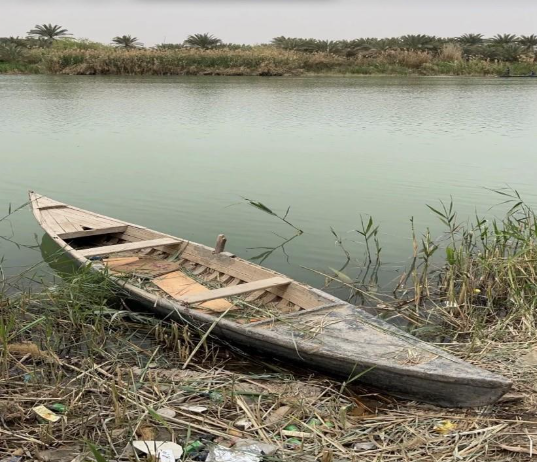
But Iraq’s rivers are no longer what they once were.
Why They Are Leaving
For decades, Mandaeans have faced a lethal mix of insecurity, lack of government protection, and environmental collapse. After the 2003 U.S. invasion of Iraq, religious minorities became prime targets for extremist groups. Mandaeans, whose faith prohibits carrying weapons, were threatened, kidnapped, and killed, often targeted for their historic association with goldsmithing. According to EISMENA, worsening security after the invasion pushed migration rates among Mandaeans to nearly 90 percent.
“After the invasion, it became dangerous for minorities like us,” says Diaa Alsabti, a Mandaean now living in Canada. “Many families were threatened or forced to leave. Safety became more important than anything else.”
While security conditions for minorities have slightly improved in recent years, another pressure has intensified: pollution.
Pollution as a Push Factor
The Tigris and Euphrates rivers are now among the most polluted in the region. Untreated sewage, industrial waste, agricultural runoff, and oil contamination flow directly into Iraq’s waterways. Climate change and upstream damming by Turkey, Iran, and Syria have further reduced water flow.
“Over 70 percent of Iraq’s water comes from upstream countries,” says Sabah al-Baydani, Director General at Iraq’s Ministry of Water Resources. “When you combine reduced flow with a lack of wastewater treatment, the rivers become toxic. This is not just affecting minorities like the Mandaeans, it affects all Iraqis.”
In 2018, the crisis became impossible to ignore. Human Rights Watch reported that more than 118,000 people in Basra were hospitalized after drinking contaminated water, triggering mass protests against government mismanagement.
For Mandaeans, polluted rivers are not only a public health risk but a spiritual dead end. Baptism, the core of their religious life, must take place in natural running water. As rivers become unsafe, many are forced to abandon rituals or perform them in hazardous conditions.
Where They Are Going
As a result, Mandaeans have migrated in large numbers to Germany, Sweden, the Netherlands, Canada, and Australia, countries that offer asylum pathways and religious freedom. Europe now hosts the largest Mandaean diaspora.
Across the diaspora, communities are trying to preserve their roots. “Last summer, there was a festival held in Michigan where Mandaeans from across the U.S. and Canada gathered, and many baptisms were performed,” Diaa explains. “Our religious leader, Sheikh Sattar Jabbar Al-Hilu, flew in from Baghdad to oversee the baptisms. Moments like that remind us that our faith is still alive, but they also show how far we’ve been pushed from home.”
Displacement also threatens the community’s future. Mandaeans practice strict endogamy and do not permit conversion. With families scattered across continents, young Mandaeans face shrinking marriage prospects, raising fears that the sect itself could fade within generations.
A Disappearing Diversity
When asked if he would ever return to Iraq, Diaa’s answer is immediate. “Absolutely,” he says. “I would go back in a heartbeat, but only if there were real protection, real security, government support, and guarantees that we wouldn’t be threatened again for who we are.”
Ironically, as Iraq loses ancient communities like the Mandaeans, Europe gains them. From Berlin to Stockholm, Mandaeans are rebuilding lives and preserving traditions that can no longer survive at home.
Europe may call it asylum. But from Iraq’s perspective, it looks more like a quiet transfer, one where safety is exported and diversity is steadily drained away.
As polluted rivers push ancient communities from their banks, Iraq is left poorer, not only environmentally, but culturally. And while European cities grow more diverse, the land that once nurtured humanity’s earliest civilizations grows emptier, one riverbank at a time.